
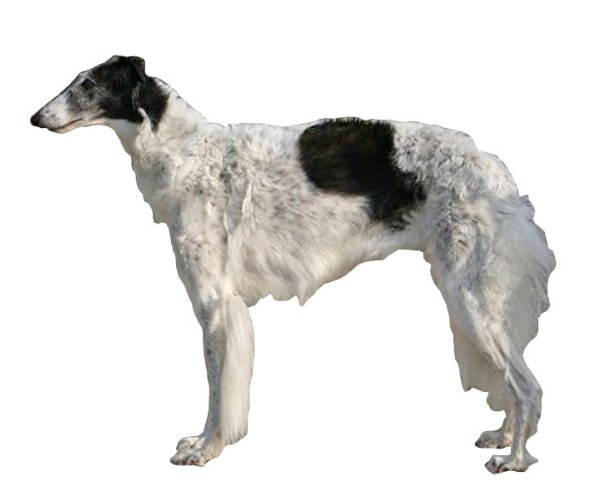
The Barzoï: Russia’s Elegant Greyhound
Despite its controversial origins, the Barzoï is believed to have originated in Russia, which likely contributes to its nickname, the Russian Greyhound. A product of crosses between long-haired Asian Spitz-type dogs and the Laika, the Barzoï was originally used for draft work and hunting.
It is believed that further crosses eventually evolved into the companion dog we know today as the Barzoï. The first Russian Greyhound is thought to have appeared in Europe around the 11th century. Anna of Kiev, the daughter of the Grand Prince of Kiev and wife of King Henry I, reportedly arrived at a hunting event at the beginning of the century, escorted by three magnificent greyhounds: one fawn, one grey, and one black.
Through the monarchy, around 1519, Russian greyhounds were brought from Muscovy and presented as a gift to Francis I by Christian II, the King of Denmark. The unique and highly prized hunting tradition in Russia helped to publicize the breed.
Bred in packs, the Barzoï hunts boar, deer, wolf, fox, and hare. Later, it made its way to other European countries, such as England and France, before crossing the ocean to America. This aristocratic dog is featured in numerous artistic representations.
The Barzoï stands as a true icon, appearing in paintings, sculptures, illustrations, photographs, and more. It can be found sculpted in bronze, painted on porcelain or faience, and illustrated on various postcards.
After World War II, the breed nearly disappeared entirely in Europe. Fortunately, the Barzoï was already well-known and appreciated in America, which helped prevent the extinction of the Russian Greyhound.
Although it did sink somewhat into obscurity during this period, particularly as a hunting dog, it quickly became a beloved companion worldwide.
>
